Showing posts with label Ucas. Show all posts

Saturday, 6 April 2013

Sheffield Hallam Accommodation

Charlotte court looks nice, and it would be in my budget if I were to live here.

Another I'd consider would be Anvil, it looks homely and I think I'd enjoy living there.


NTU Accomodation

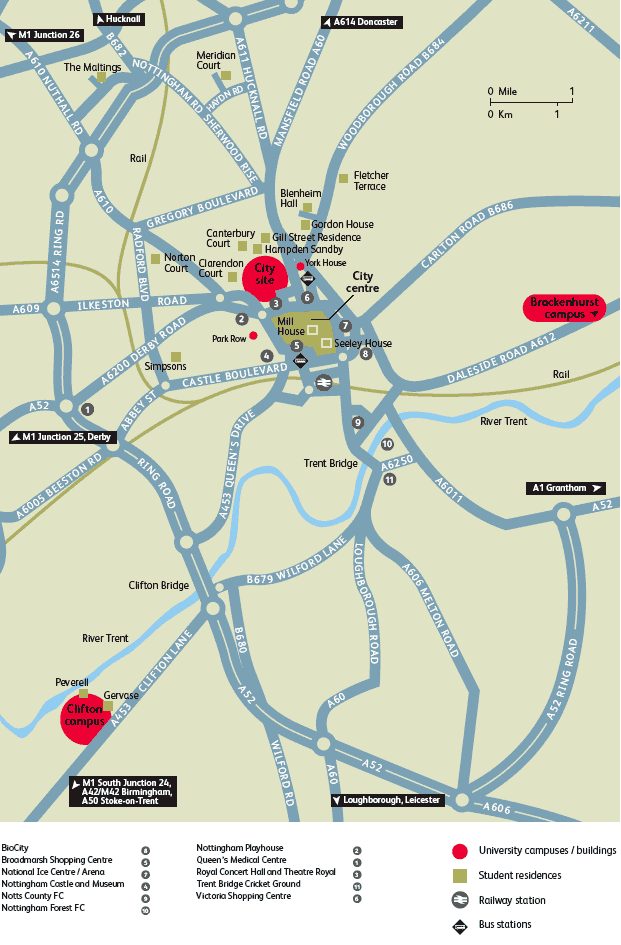
I like the look of Norton, but it's not somewhere I'd like to live, it doesn't look like a home to me, though it's in the right price range for my student finance.

Gill Street is a nice accommodation, but it's a little too expensive for my student finance.

Blenheim is a good accommodation as it's not too expensive for me and I can still have a walk to the building in a morning. I'd like to be here if I can get a place in their accommodation.


Friday, 22 February 2013

NTU Decorative Arts

http://www.ntu.ac.uk/apps/pss/course_finder/113265-1/5/ba_(hons)_decorative_arts.aspx

"I would recommend NTU because of the brilliant facilities and technicians and the creative atmosphere in the Bonington building."
 
"Why choose this course?
This degree gives you a unique opportunity to explore, develop and create with a variety of traditional and modern materials, including:
ceramics
glass
metal
paper
plastic
textiles
wood.
It is a modular degree course, designed to give you a mix of practical, theoretical and technical skills."
 
"What will I study?
As well as studio and workshop sessions, you'll learn through tutorial, seminars, lectures, and regular visits to galleries, active workshops, design practices, businesses, and museums.
Year One
  • You'll get involved in studio and workshop projects, working across a wide range of materials and developing craft skills
  • You will learn essential practical IT skills like computer-aided design (CAD), to develop forward through your degree.
Year Two
  • You will work on specific design briefs, developing more in-depth technical and craft skills.
  • The business-focused modules will develop your commercial awareness of marketing, product development, planning and communication.
  • You will undertake short work experience placements, supported by tutorial staff, are designed to hone your skills.
Year Three
  • You can choose a specialist area and develop your creative practice, then put together a dissertation and exhibition of your work.
  • You can opt for our live trading module as an alternative to a dissertation. It's a commercially focused option that involves producing a business plan and, ultimately, launching a new product in a commercial or retail environment - for the last two years we've opened our own commercial Decorative Arts shop as part of the module
  • The final-year degree show provides an important and exciting showcase for your work."
"How will I be assessed?
This is based on coursework, with the final year featuring an exhibition of work and a written project."


Sunday, 3 February 2013

NTU Fine Art

"The course's strength for me was most definitely the tutors."
"This course gives you the opportunity to experiment across the range of Fine Art media which includes painting, drawing, casting, installation, curation, sculpture, performance, photography, film, video, sound and print. You'll then choose one or two which best suits your own practice."
"Fine Art facilities
  • Glass kilns for glass work
  • potter’s wheels
  • a ceramic digital printer
  • casting and moulding equipment
  • metal workshops adapted for specialist metal usage
  • woodworking workshop and equipment
  • resin and plastics development equipment
  • polymer 3D printer
  • vinyl cutter
  • hand screen printing, transfer printing, collograph printing
  • black and white and colour darkrooms, enlargers and processors
  • three full-size photographic studios with backgrounds and lighting
  • video editing facilities."

"Recent graduates from this course have gone on to establish themselves as artists in their own right, while others find work in a range of directly related areas as curators, teachers, gallerists, animators, musicians, community artists and film-makers.


Some graduates chose to develop a ‘portfolio lifestyle’, undertaking part-time employment to help facilitate their personal artistic development and career path."

Saturday, 2 February 2013

Sheffield Hallam Creative Art Practice

"This course focuses on traditional art forms and practices. You develop your art practice using traditional media.
Drawing is a central part of the course in levels one and two.
At level one, you take workshops in • sculpture • painting • printmaking • photography. You study art, history and theory to help place your practical work in a wider context. You also choose an optional module from any available in the faculty or take a foreign language.
During level two, you choose two subjects from • sculpture • painting • printmaking • photography. You choose another optional module from any available in the faculty or continue studying a foreign language.
At level three, you specialise in either • drawing • sculpture • painting • printmaking • photography. You also study a module that develops business and work-based knowledge to help you reach your goals after graduation.
Towards the end of the course, you develop a large body of work which you exhibit in a professional environment."

"This course helps you to develop a career as a professional visual artist working as a • painter • printmaker • sculptor • photographer.
Some of our previous art graduates now work in the visual arts as • curators • writers • managers • technicians • set designers • prop makers • art directors • animators."

"Normally one of the following
• 240 points from at least two GCE/VCE A levels or BTEC National qualifications including art and design or a media-related subject. AS levels and Key Skills may count towards these points."

Leeds College of Art Fine Art

"Doing a Foundation Diploma?
if you’re studying an accredited foundation diploma in art and design, you’ll need a minimum of 260 UCAS tariff points** from that plus your AS and A2 or Extended Diploma results You may add together AS/A2/Extended Diploma and Foundation Diploma tariff points in arriving at 260 points. You’ll also need a GCSE grade A*-C in English Language, English Literature or equivalent (see above)."

"The BA (Hons) in Fine Art involves you in a diverse, lively community of people experimenting, challenging, learning and engaged in the business of being an artist in the contemporary world. This studio-based programme is structured around a system which houses four specialist subject strands in Fine Art to enable you to experience a deeper acquistion and performance of skill in your favoured media."

"DESTINATION CAREERS

Graduates go into a wide variety of careers including independent art practice, community arts, curating and teaching. Some go on to further study at master’s or doctorate level."

"WHAT YOU’LL STUDY

Year One you’ll embark on a common introductory programme with a strong emphasis on drawing, an approach for which the College is renowned. This is an initial period of orientation, induction and familiarisation after which you will confirm your place within a specialist strand and join the community of practice of your choice in semester 2.

Year Two you’ll develop your work in your specialist strand where tutorials and critiques will extend your studio practice. You will enhance your professionalism through specific modules which focus on artists’ strategies and exhibition practice.

Year Three you’ll consolidate your informed and positioned practice working within the specialist studio strand, undertaking tutorials and critiques to mentor you through your final year. You will position yourself as an emerging professional artist, undertaking an agreed project in the form of a public exhibition and an extensive research project."

Tuesday, 29 January 2013

Sheffield Hallam Fine Art

"Successful applicants will normally have passed a foundation course in art/design or BTEC National Certificate/Diploma in art/design. Applicants must have a portfolio of creative art work available for consideration at interview. Exceptionally, applications will be considered from candidates with one of the following
• Curriculum 2000 A levels – 240 tariff points from a minimum of two GCE A levels. AS level and key skills may count towards the score."

"We support and encourage you to produce work based on an understanding of the relationship between the process of making and the context of showing. You examine a range of fine art practices to help you identify and establish creative strategies for developing your own studio practice.
You work in our purpose built studios and well-equipped workshop facilities to gain and improve skills in • painting • printmaking • film • photography • video • sculpture • performance • animation • installation • sound • electronic and digital media."

"Level one modules
• workshop skills • studio practice • critical evaluation of your work and that of others • critical and theoretical practice • contemporary issues in fine art • field trips • professional artist talks

Level two modules

• studio research and workshop production • professional exhibition of work • theoretical study specialism (for example art and philosophy, or experimental film and video) • exchange opportunities • professional artist talks

Level three modules

• studio research and production • seminar / presentations and exhibiting • degree exhibition"

"Our recent graduates have developed careers in commercial and public arts sectors such as • film directing • producing • editing • sound recording • lighting/camera.
Some work in the visual arts as • curators • writers • managers • technicians. Others work in the performing arts as • performance artists • actors • set designers • prop makers.
Some graduates have become successful • comedians • novelists • scriptwriters • art directors • animators • musicians. You can also become a teacher or art therapist after further training."
Sunday, 4 November 2012

Sheffield Hallam Open Day


I'm actually really glad I went to Sheffield Hallam's open day as it's helped me to ask questions and find out what current students think about the place; although the talk was only half an hour, I made the most out of questioning the lecturer on the Fine Art course and the different aspects within it.
The facilities seem a lot more spread out and more technical than at college which I would love to try out on the first few weeks there (when I get in, optimism). If I get the opportunity to, I'd like to go back again just to have a better look around the accommodation, but I'm almost sure as to this is where I want to go to study.